Washing & Drying
How to Remove Bird Droppings and Tree Sap From Car Paint
How to safely remove bird droppings car paint damage and sticky tree sap without scratching the clear coat, plus how to check for etching afterward.
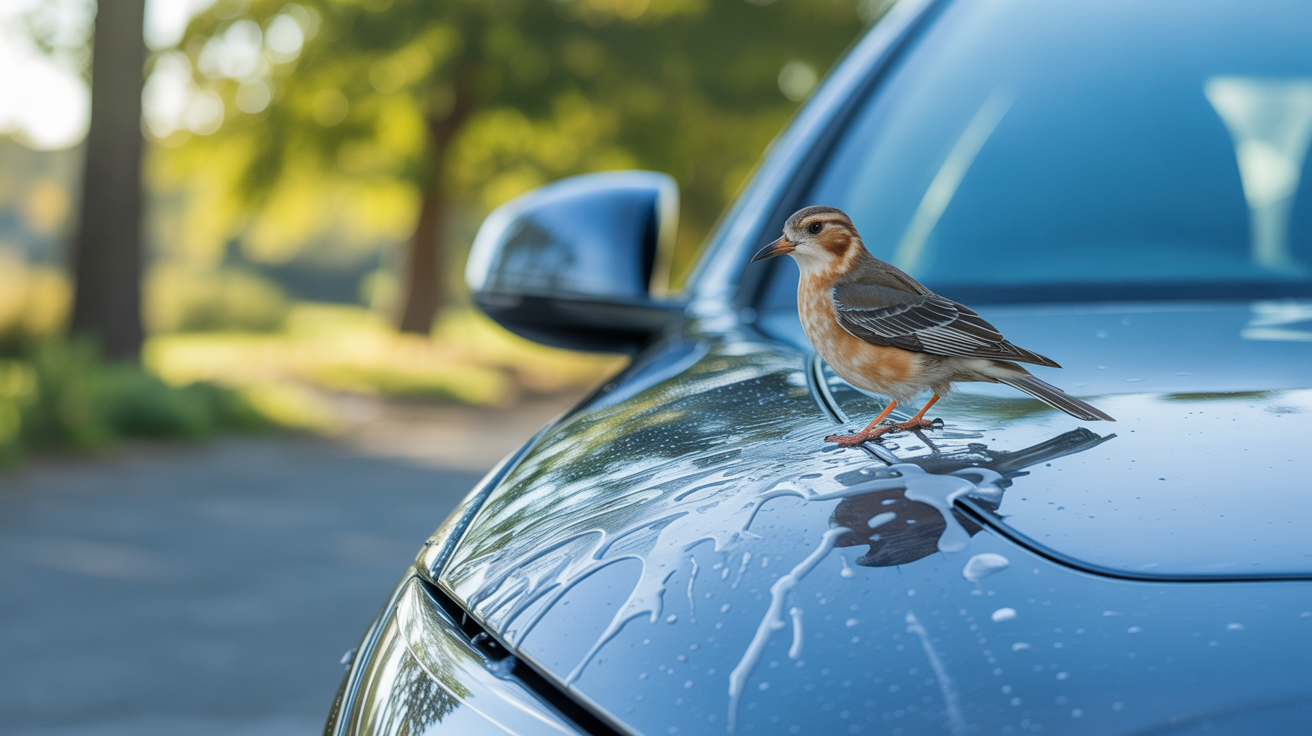
If you just found a fresh (or worse, sun-baked) splatter on your hood, you're right to want it gone now rather than later. Bird droppings and tree sap are not the same problem as ordinary road grime, and treating them like regular dirt is how people end up with a permanent ring etched into their clear coat. The good news is that removing bird droppings from car paint safely just takes the right order of operations and a little patience, not a trip to a body shop.
Why These Stains Are More Urgent Than Regular Dirt
Dust and mud sit on top of your paint and mostly just need to be rinsed and washed away. Bird droppings and tree sap behave differently, and both can cause real bird poop car paint damage if you leave them sitting.
Droppings are acidic, and that acidity is the actual threat. Given enough time and enough heat from the sun, the acid can start etching into the clear coat, leaving a dull, slightly sunken mark that a wash won't fix. How fast that happens varies a lot: a cool, shaded car might have hours of grace, while a dark-colored hood baking in direct August sun can show early etching much sooner. There's no fixed clock on it, but the pattern is consistent: heat and time both work against you.
Tree sap is a different kind of problem. It's not acidic in the same way, but it's sticky and it cures. Fresh sap is soft and comes off with the right solvent. Sap that's been baking on your paint for a season turns hard and glassy, and at that point it's bonded to the surface and often needs mechanical help (a plastic razor blade or clay bar) instead of just a wipe.
Either way, the fix is the same philosophy: soften first, lift gently, never scrub while it's still gritty.
Removing Bird Droppings From Car Paint
What you need
- Warm water in a spray bottle or a bucket
- A dedicated bug and tar remover or a pH-neutral car wash soap solution
- Two or three clean, plush microfiber towels
- Optional: a quick detailer spray for the final wipe
Step by step
- Soften it first. Spray warm water directly on the dropping and let it sit for a couple of minutes. Warm water alone breaks down a surprising amount of the residue. If it's dried on hard, soak a folded microfiber towel in warm water and lay it over the spot for a few minutes instead of spraying, since that keeps the moisture in contact longer.
- Add product if needed. For anything that isn't loosening with water alone, mist on a bug and tar remover or a wash-strength car soap solution and give it another minute or two to work.
- Lift, don't scrub. Fold a clean microfiber towel so you have a fresh section, and gently lift the softened residue off the paint. Work from the outside of the spot inward so you're not dragging grit across clean paint. If you feel any resistance or grit, stop, add more water or product, and try again rather than pressing harder.
- Rinse and dry the area. Once the spot is gone, rinse with plain water and dry with a separate clean towel so you're not reintroducing any of the residue you just removed.
If you're dealing with several spots across the car, this is a good moment to just do a full wash rather than spot-treating one panel at a time. Our guide on how to wash a car without scratching it covers the two-bucket method and towel handling that keeps a full wash from adding new marks while you're at it.
Getting Tree Sap Off Without Leaving a Mark
Sap responds to solvents better than it does to soap and water, and the right one depends on how fresh it is.
For sap that's still soft and glossy, isopropyl alcohol on a microfiber towel is usually enough. Dab it onto the spot, let it sit for thirty seconds, then wipe. A citrus-based detailing spray works the same way and is a bit gentler on any nearby wax or sealant, so it's the better first try if your paint has a protective layer you want to keep intact.
For sap that's cured hard, go slower:
- Soak a towel in isopropyl alcohol or a citrus solvent and lay it directly over the spot for a few minutes so the solvent has time to soften the sap from the surface down.
- Wipe with light pressure. If it's still hard, repeat the soak rather than pushing harder with the towel.
- If the sap has built up a raised bump that won't wipe away, a plastic razor blade held nearly flat against the paint can shave it down, but this is easy to get wrong on your first try. If you're not confident, a clay bar pulled across the softened spot is a safer way to lift the last of it without any risk of a blade angle gouging the clear coat.
- Wash the area afterward with a proper car wash soap to remove any solvent residue. Skipping this step is a common mistake. If you're unsure what's safe to use here, our breakdown of choosing a car wash soap and what to avoid explains which formulas are safe around wax and ceramic coatings and which ones will strip them.
Never use a metal scraper, a stiff-bristle brush, or a dry paper towel on sap. All three are how a sticky spot turns into a scratched one.
Checking for Etching and When to Polish
Once the spot is clean, run your fingertip lightly over the area and then look at it from a low angle in bright light, ideally sunlight or a strong flashlight held at a shallow angle to the panel. You're checking for three things:
- A dull spot where the surrounding paint is glossy. This usually means the clear coat has been etched slightly.
- A ring or halo shape that outlines exactly where the dropping or sap was sitting.
- Roughness under your fingertip compared to the paint around it, which often shows up alongside water spot etching too.
Light etching that hasn't gone very deep often buffs out with a machine polish, the same process used for swirl marks and light scratches. If you're already seeing this kind of surface damage, it's worth reading our guide on how to remove swirl marks from car paint, since the polishing steps and product choices overlap directly with etching correction.
If the mark is deep enough that you can feel a noticeable dip or the dullness doesn't respond to a light polish, that's a sign the etching has gone past the clear coat's surface layer, and a professional paint correction is the more realistic fix rather than repeated DIY passes that just remove more clear coat each time.
It's also worth checking the rest of the panel for water spots while you're at it, since hard water left to dry on a hot hood causes a similar kind of mineral etching. If you notice cloudy spots nearby, our guide on how to remove water spots from car paint walks through the same soften-and-lift approach, adapted for mineral deposits instead of biological residue.
Frequently Asked Questions
How quickly do I need to remove bird droppings from my car?
As soon as reasonably possible, ideally the same day. There's no exact time limit before damage happens since it depends on heat, sun exposure, and the specific dropping, but the acid has more chance to etch the clear coat the longer it sits, especially in direct sun.
Will rubbing alcohol damage my car's wax or ceramic coating?
It can strip wax with repeated or heavy use, and it's not ideal on a fresh ceramic coating either. For sap removal, use it sparingly, only on the spot itself, and follow up with a wash and a fresh coat of wax or sealant if you've used it over a larger area.
Can I use a pressure washer to remove dried bird droppings?
A pressure washer alone usually won't fully lift dried, crusted droppings and can push water under trim or into seams you'd rather keep dry. It's fine for an initial rinse before you apply product, but plan on finishing with a towel and remover rather than relying on water pressure to do all the work.
What if the bird dropping has already left a stain after I clean it off?
If the residue is gone but a dull or slightly discolored mark remains, that's likely light etching rather than surface staining. Try a light machine or hand polish on just that spot before assuming you need a full correction; many light etch marks respond well to polish alone.
Is it safe to use dish soap to remove tree sap?
Dish soap can help with very fresh, still-tacky sap in a pinch, but it's not formulated for paint and can strip wax with regular use. For anything more than an occasional emergency wipe, a dedicated bug and tar remover or an isopropyl alcohol solution designed for detailing does the job more reliably and is gentler on any existing protection.