Washing & Drying
Foam Cannon vs Foam Gun: What Actually Works
Foam cannon or foam gun? Learn what each tool actually does, which soap to use, and whether thick snow foam is worth the effort.
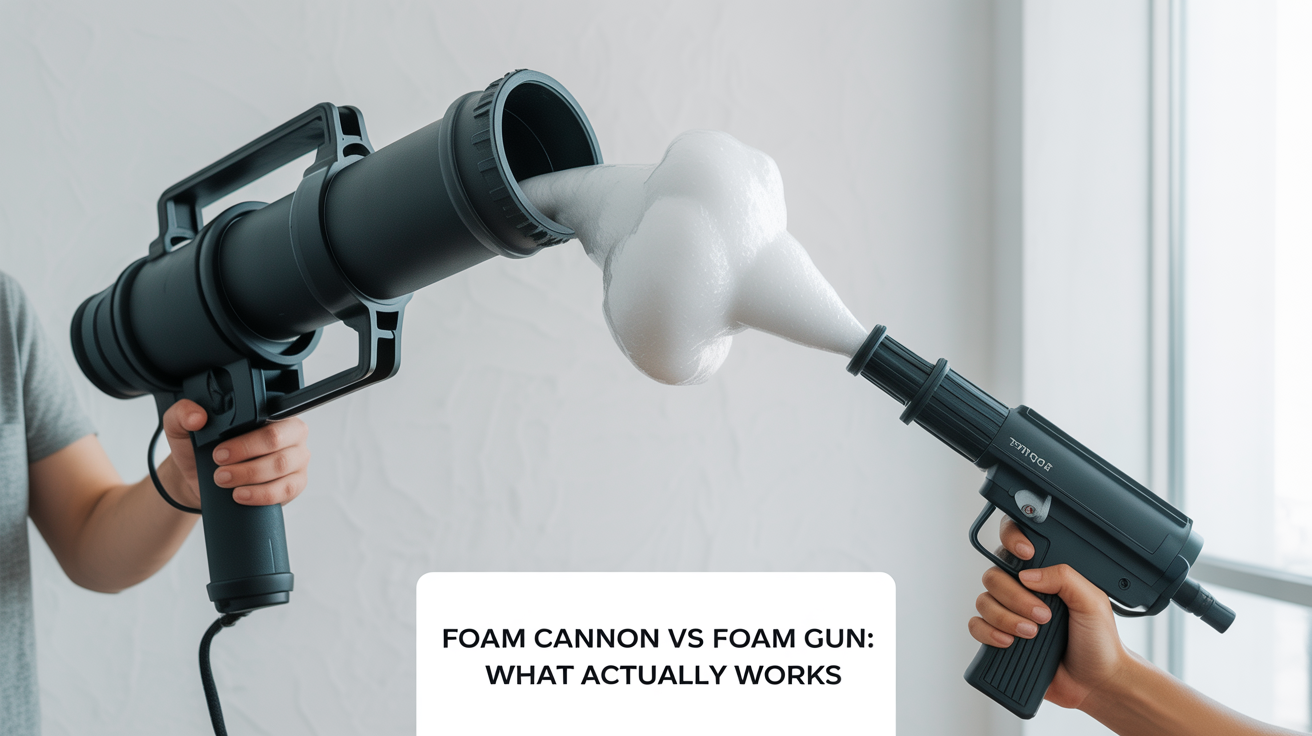
Thick white foam dripping off a car looks satisfying. It also sells a lot of equipment. Before you buy either a foam cannon or a foam gun, it helps to understand what pre-wash foam actually does, what the difference between the two tools is, and where the hype ends.
What pre-wash foam is actually doing
Snow foam is a pre-wash step, not a wash. The goal is to loosen and lift loose dirt, dust, pollen, and road grime before you ever touch the paint with a mitt. That matters because dragging abrasive particles across a clear coat with a wash mitt is the main cause of swirl marks and fine scratches.
Foam clings to vertical surfaces, dwells for a few minutes, and then carries contaminants away when you rinse. What it does not do is dissolve bonded contamination like brake dust, tar spots, or industrial fallout. Those need a dedicated iron remover or tar remover. Foam is a pre-rinse with better cling, and that framing should guide every decision you make about it.
If your car is only lightly dirty, a thorough rinse with a hose or pressure washer before your two-bucket wash achieves something similar. Foam earns its place on a vehicle that has been sitting for a week or collected a heavy layer of dust and organic debris.
Foam cannon vs foam gun: the core difference
The single most important distinction is the water source.
A foam cannon connects to a pressure washer. The high-pressure water (typically 1200-3000 PSI) forces through a small orifice and aerates the soap solution into dense, thick foam. Pressure washers also put out more water volume (measured in GPM), which strips foam and dirt from the surface more forcefully during rinsing.
A foam gun connects to a standard garden hose. Garden hose pressure sits around 40-70 PSI at the nozzle, which is nowhere near enough to produce the same foam density. The result is thinner, wetter lather that runs off panels faster and does not cling as long.
Neither tool is broken. They are just different tools for different setups.
Side-by-side comparison
| Factor | Foam cannon | Foam gun |
|---|---|---|
| Water source | Pressure washer (1200+ PSI) | Garden hose (40-70 PSI) |
| Foam thickness | Dense, slow-drip | Thinner, runs faster |
| Dwell time | 3-5 minutes on vertical surfaces | 1-3 minutes before runoff |
| Rinsing power | High (strips foam and grime thoroughly) | Lower |
| Upfront cost | $30-80 cannon + $150-500 pressure washer | $20-40 |
| Portability | Requires pressure washer access | Works anywhere with a hose |
| Best suited for | Heavier contamination, regular detailers | Apartment dwellers, light-duty use |
Does thicker foam clean better?
Thicker foam is more satisfying to look at. It is not inherently more effective at cleaning.
Foam does not clean by friction or penetration. It cleans by emulsifying and encapsulating dirt particles so the rinse water can carry them away. A thinner foam from a garden hose gun, if given sufficient dwell time and followed by a thorough rinse, will do essentially the same pre-wash job on a lightly soiled car.
The practical advantage of a foam cannon is dwell time. Thick foam clings to a door panel for several minutes without running to the ground. A thin foam from a gun may slide off in 90 seconds on a warm day. More contact time means slightly more emulsification. On a heavily contaminated car, that difference matters. On a car washed weekly, it barely does.
Choosing the right soap
Not every car shampoo will foam well. For foam cannon or gun use, you want a shampoo with a higher concentration designed for dilution ratios of 1:10 to 1:50. Common options like Chemical Guys Honeydew, Meguiar's Car Wash shampoo, and Koch Chemie GS dilute well and produce good foam through either tool.
Dedicated snow foam products (Bilt Hamber Auto Foam, Gtechniq W4 Citrus Foam) are formulated specifically for pre-wash use. They tend to have more aggressive detergency and are not intended for contact washing. Use them before the mitt, then follow with a proper wash shampoo during the contact stage.
Avoid dish soap. It strips wax and sealants aggressively, and it does not rinse cleanly from panel gaps.
For foam gun use, keep your dilution ratio on the richer side (closer to 1:10) since the lower pressure will not produce as many bubbles. Foam cannon setups can run thinner dilutions because the pressure aerates more aggressively.
Dwell time and process
Apply foam to a cool, dry panel or rinse the car first to wet the surface. Work one section at a time on hot days so the foam does not dry before you rinse. In full sun, a minute of dwell may be all you get before the water evaporates.
The standard process:
- Rinse the car with plain water to knock off loose debris
- Apply foam and let it dwell 2-4 minutes
- Rinse thoroughly before proceeding to contact wash
- Follow with a proper two-bucket method and a clean microfiber mitt
Do not skip the contact wash. Foam alone will not remove everything, and a car "washed" with foam and rinsed is not actually clean enough to apply protection to. Think of foam as the appetizer that makes the main wash faster and safer, not the meal itself.
After washing, how you dry matters as much as how you wash. Dragging a cheap bath towel across wet paint is just as damaging as a dirty mitt. Drying without water spots is its own topic worth reading before you get to that stage.
When a foam gun is enough
If you live in an apartment, store a car in a tight garage, or wash your car in a space where a pressure washer is impractical, a foam gun is a reasonable tool. You will not get the same visual spectacle, but the pre-wash function is still there.
If you already own a pressure washer and wash your car regularly, a foam cannon is a straightforward addition that does make the pre-wash step more effective. The pressure washer itself is the bigger commitment. If you are buying one specifically for car washing, factor in whether you will actually use it for other tasks, because that shifts the cost calculation.
When to skip foam entirely
On a car that has been rinsed within the last day or two and picked up only light dust, an aggressive pre-rinse with a pressure washer or hose may be all the pre-wash you need before washing without scratching. Foam is a tool in the process, not a requirement for every wash.
It is also worth noting that foam adds time. Setup, application, dwell, rinse, then wash. If you are doing a quick maintenance wash in 20 minutes, integrating a foam step may double that. Weekly washers who keep their paint clean often find they need the pre-wash step less than someone who washes monthly.
FAQ
Do I need a pressure washer to use foam cannon snow foam? Yes. A foam cannon requires a pressure washer to function as designed. It will not attach to a garden hose. If you only have a garden hose, a foam gun is the compatible option.
Can I use snow foam as my only car wash product? No. Snow foam is a pre-wash treatment. It loosens contamination so it rinses away more easily, but it does not replace a contact wash. You still need to wash the car with a mitt and car shampoo after rinsing the foam.
What dilution ratio should I use in a foam cannon? Most car wash shampoos perform well at 1:15 to 1:30 in a foam cannon's reservoir. Dedicated snow foam products often specify their own ratios. Start richer (lower ratio number) if the foam seems thin, leaner if it is not rinsing cleanly.
Does it matter what car wash soap I use in a foam gun? Yes. Use a high-foaming car shampoo designed for dilution, not a rinseless wash or waterless product. For foam guns, run a richer mix (around 1:10) to compensate for the lower aeration from garden hose pressure.
Is the foam supposed to be white and thick or is thin foam fine? Thick foam looks impressive but is not a direct indicator of cleaning performance. Thin, wet foam from a foam gun still performs the pre-wash function if given adequate dwell time and followed by a proper rinse. Thickness reflects aeration level and soap concentration, not cleaning strength.